- Four provinces have become increasingly centralised: minister.
- Political consensus essential for creating new provinces: Iqbal.
- PM’s aide says no decision taken on creating new provinces.
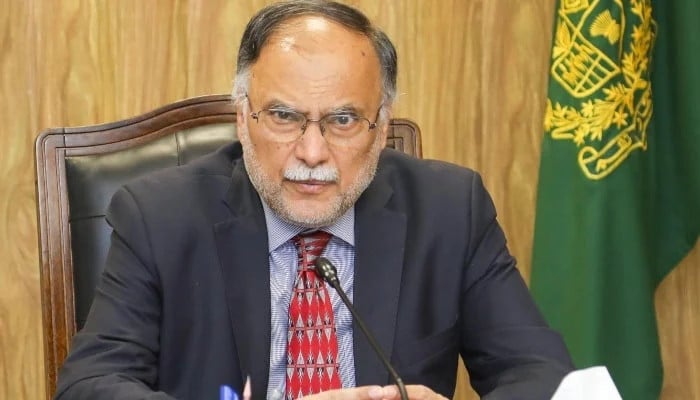
Planning and Development Minister Ahsan Iqbal has proposed the creation of 12 to 15 new provinces, urging Prime Minister Shehbaz Sharif to constitute a committee to review the country’s administrative structure.
“I have proposed that a committee be made, on administrative reforms, through the law minister that can at least start a national and political debate on what can and cannot be done,” he told The News. “At the end of the day, you need to build a political consensus to do this [create new provinces].”
Iqbal added that he was waiting for the prime minister to return from Kyrgyzstan before taking up the matter with him.
Iqbal’s proposal comes as a decades-old debate over Pakistan’s provincial structure has resurfaced. Interior Minister Mohsin Naqvi raised the issue in July, and Inter-Services Public Relations (ISPR) Director General Lt Gen Ahmed Sharif Chaudhry called for a serious debate a day later.
Minister Iqbal said Pakistan’s four provinces had become increasingly centralised and monopolistic over the years, contributing to a breakdown in the delivery of social services such as health and education.
“I would say we need 12-15 new provinces,” Iqbal said. “Divided all provinces into three each. But you will need to do an equitable distribution so for example if Punjab is divided into three provinces its share will increase in the Senate. If you want to create new provinces it has to be based on some equitable formula that does not change the representation too drastically in one direction.”
But other officials say there is no formal federal process underway yet.
Rana Ihsaan Afzal Khan, coordinator to the prime minister, told The News that no decision had been taken on creating new provinces or administrative units.
“No such committee has been made at the federal level. There is no such talk on any forum officially,” he said.
He added that even if new provinces were to be created, they would be created for the next election cycle.
An old debate returns
Pakistan currently has four provinces, two autonomous territories and one federal capital territory. For decades, political parties and regional groups have periodically called for the creation of additional provinces.
The latest debate began on July 30, when Naqvi argued that Pakistan’s existing governance structure was no longer working.
During a televised address in Islamabad, Naqvi said: “The [governance] system in the country has collapsed. We have been dragging [this system] for over 70 years.”
He proposed creating new administrative units, or provinces, as a way to address the country’s governance problems.
A day later, the ISPR DG also called for a serious debate on the proposal.
“If the population has increased by fourfold and you still have four provinces then we have to see if this is serving good governance,” the ISPR chief said while speaking to reporters.
The remarks quickly drew reaction, particularly in Sindh, where nationalist parties have long opposed any attempt to divide the province.
Since August 12, nationalist parties have held near-daily demonstrations and launched a campaign against any attempt to split Sindh.
“No child would want their mother to be divided into two… We want one Sindh,” Ayaz Latif Palijo, president of the Sindh-based Qaumi Awami Tehreek, told The News.
The opposition has not been limited to nationalist parties.
Azma Bokhari, Punjab’s information minister, called Naqvi’s remarks “unserious about a serious issue”.
This week, Pakistan Peoples Party (PPP) leader Nisar Khuhro thundered in the Sindh Assembly: “Sindh is my body and my soul. Show me, who are these people who want to cut their mother into pieces?”
Smaller provinces, better government?
The argument for creating new provinces is not new. Proposals to carve South Punjab out of Punjab and create a Hazara province from Khyber Pakhtunkhwa have existed for decades.
In 2020, the previous government established a South Punjab civil secretariat in Multan, a move seen as a precursor to a province comprising the Multan, Bahawalpur and Dera Ghazi Khan divisions.
But would smaller administrative units actually improve governance?
Umair Javed, who teaches politics and sociology at the Lahore University of Management Sciences, said academic literature on whether smaller administrative units improve governance is inconclusive, although it leans towards the view that smaller units can give people greater access to power and bring decision-making closer to them.
“It is not just about governance that has been devolved, it is also about governance that is increasing accountability,” he told The News. “In the absence of accountability, devolved governance can lead to elite capture.”
The question is not simply how many provinces Pakistan should have, but also where power should sit.
Last month, Defence Minister Khawaja Asif proposed handing Karachi in Sindh and Gwadar in Balochistan to the federation rather than making them separate provinces.
Umair Javed said the proposal would primarily benefit the federal government financially while doing little to address governance at the municipal level.
“This argument seems completely senseless to me,” he explained. “Obviously, this would become very beneficial to the federal government because the taxes they collect from these territories, especially from Karachi, will go directly into the federal pool. But the federal government does not have the mandate or the capacity to improve governance at a municipal level.”
The price of a new map
Even if a political agreement could be reached, creating new provinces would come with a substantial financial and administrative cost.
Pakistan’s fiscal space is already limited. The country narrowly avoided default in 2023 after securing a $3 billion International Monetary Fund bailout programme, followed by a $7 billion Extended Fund Facility. Three years on, the economy continues to face mounting debt, persistent inflation and weak growth.
Each new province would require elections and new institutions, including a chief minister’s office, assembly and high court. Government departments and bureaucratic structures would also have to be established, along with new salaries and administrative infrastructure.
“The country is fairly constrained in terms of the amount of spending that it can do,” Javed said. “When we create new administrative units and replicate provincial governing structures it will entail a pretty significant cost.”
And the costs would not be the only complication.
Redrawing Pakistan’s administrative map would raise questions over the division of water, land, natural resources and federal funds.
Water could prove particularly contentious.
Pakistan’s four provinces have established shares under the 1991 Water Apportionment Accord. If a province were divided, questions would arise over how its existing allocation would be distributed among the successor provinces.
Who gains?
For some, the debate is less about administrative efficiency than about who would control political power and resources.
Dr Sorath Sindhu, a political activist in Karachi, said the idea was not new and that similar proposals had gained traction under military dictatorships.
“We think this is the same old dream they [the establishment] are trying to bring again,” she said. The political stakes are high because Pakistan’s major political parties have provincial turfs to protect, with the three main parties each governing one province.
Javed argued that the current debate could put those parties in a weaker position.
“This conflict in some ways plays into the hands of the establishment,” he said. “Because now they [the establishment] are setting the terms of the debate that we through coercion are bringing a new thing so you [political parties] bargain with us. What else are you willing to concede?”
— Additional reporting by Saman Amjad, Fayyaz Hussain and Maha Kanwal.